It often means embracing and accepting your experiences so you can live in the present. So recognize the emotional toll that dwelling on something is taking on you, and then give yourself permission to move forward.
You can ease the stress of traumatic events by stepping back, taking stock of your life, and concentrating on what’s important. Strengthen bonds with family, friends, and community.
Reassess personal goals and come up with a plan to reach them.
Volunteer and give a little more to charity.
Tips for letting go
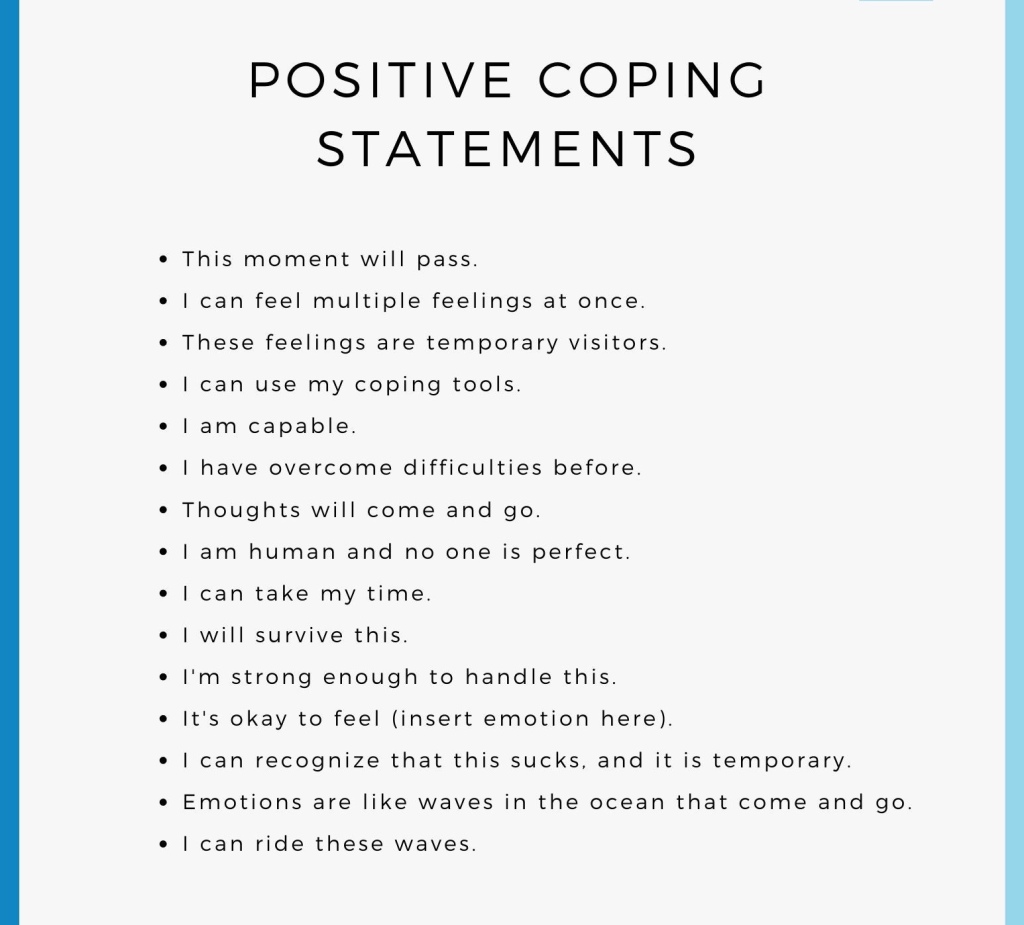
Create a positive mantra to counter the painful thoughts.
To let go of past hurts, you need to make the conscious decision to take control of the situation. However, this can take time and practice. Be kind to yourself as your practice refocusing how you see the situation, and celebrate the small victories you have.
Defined as – the capacity to accept or tolerate delay, trouble, or suffering without getting angry or upset.
Deep breaths
Deep breathing can help lessen stress and anxiety. By breathing slower and more deeply from your stomach, you signal your nervous system to calm down. Deep breathing takes practice — it won’t be immediately helpful.
😮💨
Sit comfortably on the floor or in a chair.
Breathe in through your nose. As you do it, count to five.
Breathe out through your nose to the count of five.
Repeat several times.
😮💨
Reduce stress, anxiety, and negative emotions, cool yourself down, and sharpen concentration skills with breathing meditation.
😮💨
The 4-7-8 breathing technique involves breathing in for 4 seconds, holding the breath for 7 seconds, and exhaling for 8 seconds. This breathing pattern aims to reduce anxiety or help people get to sleep. It is a form of pranayama, which is the practice of breath regulation.
😮💨
4-4-4 breathing, commonly known as box breathing, is one of the easier breathing techniques you can practise to help you calm anxiety. It’s perfect as a quick fix for reducing stress by distracting your mind and body. In fact, if you’ve taken a minute to breathe deeply then you’ve likely come close to box breathing.
Action and self-discipline are two closely related concepts that are essential for achieving goals and living a fulfilling life.
Goals
Action is the process of taking steps to achieve a goal or make something happen. It is the physical manifestation of intention and willpower. Without action, our goals remain just that – goals. We need to take action to turn our dreams into reality.
Self-discipline is the ability to control one’s own behavior and emotions in order to achieve goals or follow through on commitments. It is the ability to resist distractions and temptations, and to persevere in the face of challenges. Self-discipline is not about being harsh or punishing oneself; it is about being kind to oneself and making choices that will lead to long-term happiness and success.
Happy
Here are some of the benefits of action and self-discipline:
Increased productivity: When we take action,we get things done. This leads to increased productivity and feelings of accomplishment.
Improved goal attainment: When we are disciplined, we are more likely to achieve our goals. This is because we are able to stick to our plans and overcome obstacles.
Greater self-confidence: As we experience success, our self-confidence grows.This leads to a greater willingness to take risks and pursue new opportunities.
Reduced stress and anxiety: When we are in control of our lives, we feel less stressed and anxious. This is because we know that we are taking steps to achieve our goals and live the lives we want.
Here are some tips for developing action and self-discipline:
Set SMART goals: SMART goals are Specific, Measurable, Achievable, Relevant, and Time-bound. This type of goal is more likely to motivate us and keep us on track.
Break down large goals into smaller steps: Large goals can feel overwhelming. Break them down into smaller, more manageable steps. This will make them seem less daunting and more achievable.
Develop a routine: A routine can help us to stay on track and avoid procrastination. Schedule time for your goals each day and stick to your schedule as much as possible.
Find an accountability partner: An accountability partner can help you to stay motivated and on track. You can check in with each other regularly and offer support and encouragement.
Reward yourself: Celebrate your successes along the way. This will help you to stay motivated and keep moving forward.
Action and self-discipline are not easy, but they are essential for achieving our goals and living a fulfilling life. By following these tips, we can develop the skills and mindset we need to succeed.
Self-care is the practice of taking care of yourself to promote your mental, emotional, physical & spiritual health. (MEPS) It involves making healthy choices, managing stress, and taking time for yourself.
Time for yourself
Here are some tips for incorporating self-care into your daily routine:
Physical self-care:
Eat a healthy diet: Choose foods that are nutritious and make you feel good.
Get regular exercise: Aim for at least 30 minutes of moderate-intensity exercise most days of the week.
Get enough sleep: Most adults need around 7-8 hours of sleep per night.
Practice relaxation techniques: This could include yoga, meditation, or deep breathing.
Mental self-care:
Take breaks: Step away from work or other stressful activities throughout the day to take a few minutes for yourself.
Engage in activities you enjoy: Make time for activities that bring you joy and relaxation.
Connect with loved ones: Spend time with people who make you feel good.
Seek help when needed: If you are struggling with stress, anxiety, or depression, don’t hesitate to seek professional help.
Emotional self-care:
Practice mindfulness: Pay attention to the present moment and your thoughts and feelings without judgment.
Learn to say no: It’s okay to say no to requests that you don’t have time for or that will add stress to your life.
Set boundaries: Establish healthy boundaries with others to protect your time and energy.
Practice self-compassion: Be kind to yourself and accept that you make mistakes.
Self-care is an ongoing process, and what works for one person may not work for another. The important thing is to find what works for you and to make self-care a priority in your life.
Self-care a priority
Here are some additional tips for self-care:
Create a self-care plan: Make a list of activities that you enjoy and that make you feel good. Schedule time for these activities in your calendar.
Make self-care a part of your routine: Do something for yourself every day, even if it’s just for a few minutes.
Don’t be afraid to experiment: Try different activities to see what you enjoy.
Be patient: Self-care takes time and effort. Don’t get discouraged if you don’t see results immediately.
Listen to your body: Pay attention to how you’re feeling and take breaks when you need them.
Seek support: If you’re struggling, don’t be afraid to reach out to a friend, family member, or therapist.
Blessed are You, Lord our God, King of the universe, who has sanctified us with His commandments and commanded us to kindle the light of the holy Shabbat.
Shabbat Shalom
The blessing is recited after the candles are lit. It is customary to cover one’s eyes while reciting the blessing.
Men – wrap tefillin (daily)
You shall bind them as a sign upon your hand, and they shall be for a reminder between your eyes.
You have a brain. It is in one world. Your heart is in another. And your hands often end up involved in something completely foreign to both of them. Three diverse machines.
So you put on tefillin. First thing in the day, you connect your
head
heart
hand
with these leather cables—all to work as one, with one intent: a dedicated service of the Almighty.
And then, when you go out to meet the world, all your actions find harmony in a single coordinated purpose…
Tefillin are a pair of black leather boxes containing Hebrew parchment scrolls. A set includes two tefillin—one for the head and one for the arm. Each consists of three main components: the scrolls, the box and the strap. The scrolls are inserted into boxes made of leather that have been painted black.
One box is strapped on your head, and the other onto your arm next to your heart. It’s done once a day—preferably during the morning prayers.
If that is not practical, say at the Shema. It’s done by Jewish males, age 13 and up, every day except Shabbat and major Jewish holidays.
Arm- (non dominant) Place the black box up on your bicep, just below the halfway point between the shoulder and the elbow, right across from your heart
Blessed are You, L‑rd our G‑d, King of the universe, who has sanctified us with His commandments, and commanded us to put on tefillin.
Bind arm
two more times over the strap-socket of the black box and around the biceps, then seven times around your arm and once around your palm. Leave the remainder of the strap loose.
Head –
Then back to hand: Wrap the remainder of the strap three times around your middle finger
once around the base,
then once just above the first joint,
then one more time around the base.
You’ve got some strap left over, so wrap it around your palm and tuck in the tail end.
Pray
Meditate for a moment.
Be conscious that G‑d Himself commanded that tefillin contain four Biblical passages which mention His Unity and the Exodus from Egypt, in order that we remember the miracles and wonders He performed for us, demonstrating that He has power and dominion over all.
He has enjoined us to place the tefillin on the arm adjacent to the heart, and on the head over the brain so that we submit our conscious soul (which is in the brain), as well as the desires and thoughts of our heart to Him.
Thus tefillin serve as an inspiring springboard to serve G‑d in a state of inspiration and to study Torah, His wisdom.
At very least, take a moment to remind yourself that tefillin is a mitzvah (commandment) of G‑d.
Tefillin
If this is not possible, at least say the Shema prayer
In the original Hebrew:
Cover your eyes with your right hand and say:
Recite the following verse in an undertone:
Transliteration:
Cover your eyes with your right hand and say: Sh’ma Yis-ra-eil, A-do-nai E-lo-hei-nu, A-do-nai E-chad.
Recite the following verse in an undertone: Ba-ruch sheim k’vod mal-chu-to l’o-lam va-ed.
Cover you eyes with your right hand and say: Hear, O Israel, the L‑rd is our G‑d, the L‑rd is One.
Recite the following verse in an undertone: Blessed be the name of the glory of His kingdom forever and ever.
You shall love the L‑rd your G‑d with all your heart, with all your soul and with all your might. These words which I command you today shall be on your heart. You shall teach them thoroughly to your children, and you shall speak of them when you sit in your house and when you walk on the road, when you lie down and when you rise up. You shall bind them as a sign upon your arm, and they shall be for a reminder between your eyes. You shall write them upon the doorposts of your house and upon your gates.
1. Acceptance does not mean liking, wanting, choosing, or supporting.
2. Acceptance is an active process. It must be practiced.
3. Acceptance doesn’t mean that you can’t work on changing things.
4. Acceptance doesn’t mean you’re accepting it’s going to be that way forever.
5. We can practice acceptance toward our experience, people, appearance, emotions, ideas, and more.
Acceptance defined as the action of consenting to receive or undertake something offered.
the action or process of being received as adequate or suitable, typically to be admitted into a group.
Radical Acceptance
a mindfulness-based practice that involves accepting things as they are, without judgment or resistance. It is based on the idea that struggling against reality only causes more suffering. When we radically accept our circumstances, we can let go of negative emotions and focus on what we can control.
Radical acceptance is not about giving up or resigning ourselves to a difficult situation. It is about acknowledging the truth of our situation and choosing to move forward with compassion and understanding. It is about accepting ourselves and our lives, flaws and all.
Radical acceptance can be helpful in a variety of situations, such as:
Dealing with chronic pain or illness
Coping with grief and loss
Dealing with difficult relationships
Managing stress and anxiety
Overcoming addiction
Accepting our physical appearance
Embracing our personal flaws
To practice radical acceptance, we can start by acknowledging our thoughts and feelings without judgment. We can then ask ourselves: What is the reality of the situation? What can I control? What cannot I control? Once we have a clear understanding of the situation, we can choose to accept it as it is.
Radical acceptance does not mean that we have to like what is happening. It simply means that we choose to accept it as reality. When we radically accept our circumstances, we can let go of negative emotions and focus on what we can control. We can also open ourselves up to new possibilities and opportunities.
Here are some tips for practicing radical acceptance:
Be mindful of your thoughts and feelings. Acknowledge your thoughts and feelings without judgment. Observe them with curiosity and compassion.
Identify what you can and cannot control. Make a list of the things you can and cannot control in the situation. Focus on what you can control and let go of what you cannot control.
Accept reality as it is. Once you have a clear understanding of the situation, choose to accept it as it is. This does not mean that you have to like what is happening, but it does mean that you choose to let go of negativity and resistance.
Practice self-compassion. Be kind and understanding towards yourself. Remember that everyone makes mistakes and that no one is perfect.
Seek support from others. Talk to a trusted friend, family member, or therapist about your experiences. Having support from others can help you to practice radical acceptance and cope with difficult situations.
Radical acceptance is a skill that takes time and practice to develop. Be patient with yourself and don’t get discouraged if you don’t see results immediately. With regular practice, you will learn to accept your life as it is and find peace and happiness within yourself.
According to the dictionary, love is “an intense feeling of deep affection.”
Detachment is the state of being objective or aloof
Detaching with Love
Detaching (or detaching with love) is a core component of codependency recovery. If you often feel worried about a loved one, disappointed or upset by their choices, or like your emotions revolve around whether theyre doing well or not, then detaching can help you.
Hearts on, Hands off
Codependency expert Melody Beattie says that when we detach, we relinquish our tight hold and our need to control in our relationships. We take responsibility for ourselves; we allow others to do the same.
Personal Responsibility
Balanced living means achieving optimal health in all aspects of your life: relationships, work, fitness, health, and emotional happiness. We all get so caught up in work and family responsibilities, that we forget to make time for ourselves.
“MEPS”
Mentally
Emotionally
Physically
Spiritually
Balance
How to Get Your Life Back Into Balance
Be reasonable. People have a limit to resources like time, money, and energy. …
Find a support system. …
Take control and say no. …
Make a schedule for rest. …
Focus on today.
Recovery
Detachment with love means caring enough about others to allow them to learn from their mistakes. It also means being responsible for our own welfare and making decisions without ulterior motives-the desire to control others.
Overcoming Codependency
Perhaps the essence of detachment with love is responding with choice rather than reacting with anxiety.
How do you manifest? This can be done in a variety of ways—prayer, meditation, visualization, speaking your intentions out loud, a vision board and/or a “future box,”which is a container full of pictures of items you want to manifest—but you need to say exactly what you want.
How do you make something happen?
Here are six steps:
Make a decision to have what you want, even if you don’t know how to get it.
Be clear about the outcome.
Detach from the process.
Expect that it will happen.
Be open to possibility when things don’t go your way.
Practice gratitude.
What is it that you want? Become unapologetic about what you want. Own it. Believe it. Trust that it can be yours. Write it down right now.
“I am not what happened to me, I am what I choose to become.”
“The future belongs to those who believe in the beauty of their dreams.”
“I choose to make the rest of my life the best of my life.”
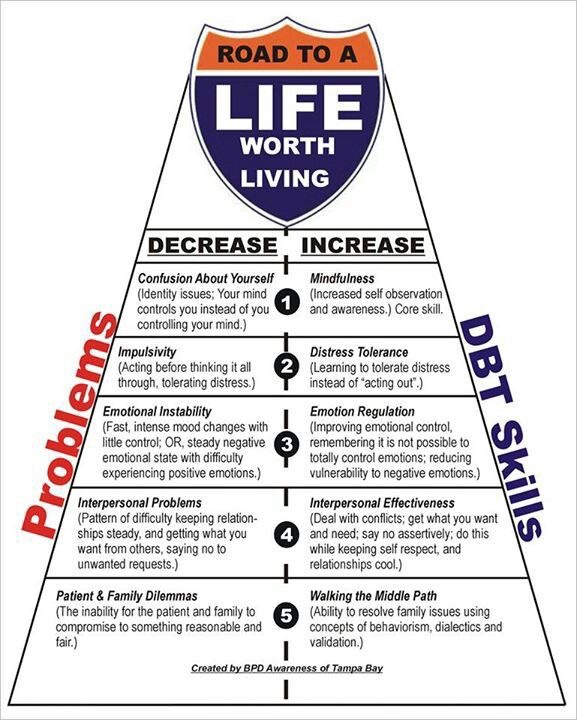
Dialectical behavior therapy is an evidence-based psychotherapy that began with efforts to treat personality disorders and interpersonal conflicts. Evidence suggests that DBT can be useful in treating mood disorders and suicidal ideation as well as for changing behavioral patterns such as self-harm and substance use.
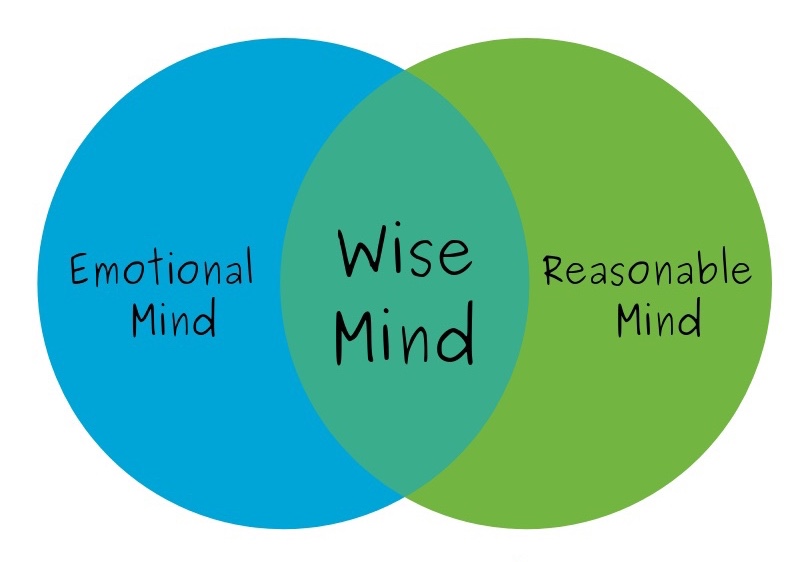
The main goal of therapists who use dialectical behavior therapy (DBT) is to strike a balance between validation (acceptance) of who you are and your challenges and the benefits of change. You will learn new skills to improve emotion regulation.
The four skills include:
Mindfulness: This is the practice of being fully aware and focused in the present instead of worrying about the past or future.
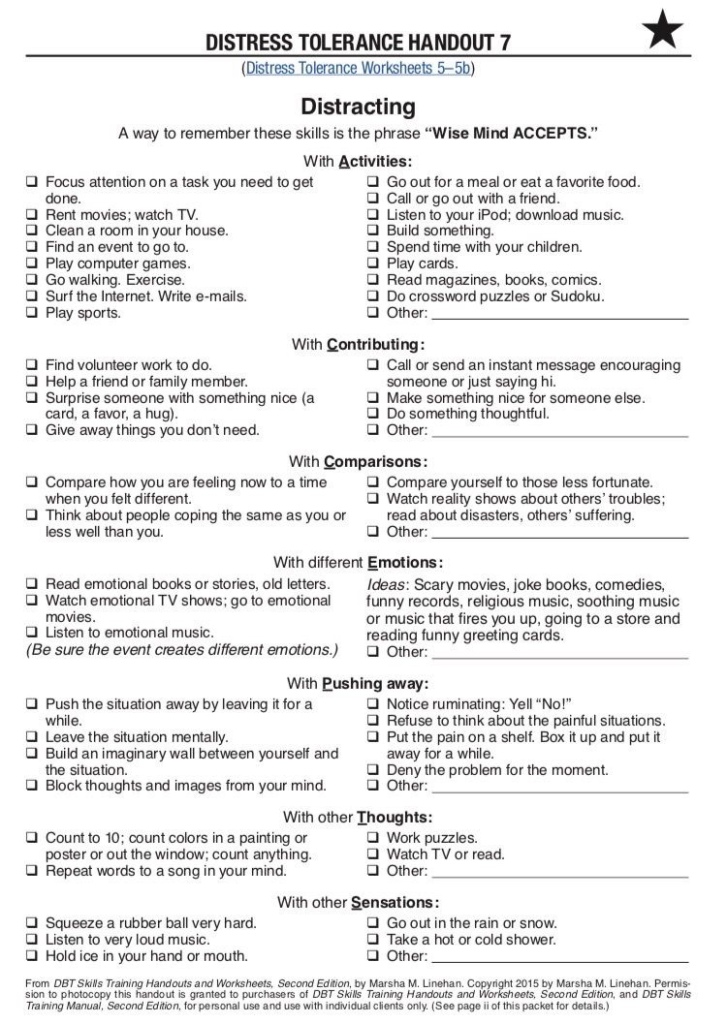
Distress tolerance: This involves understanding and managing your emotions in difficult or stressful situations without responding with harmful behaviors.
Interpersonal effectiveness: This means understanding how to ask for what you want and need and setting boundaries while maintaining respect for yourself and others.
Emotion regulation: This means understanding, being more aware of and having more control over your emotions.
There is no use in being upset over situations that have already happened and cannot be changed.
The quote directs you to not dwell in the past and cry about what happened. Especially when you cannot change it. It’s okay to be sad but don’t let it stop your life. Instead, cherish the moments spent with them and be grateful for the moments shared.
I am grateful 🥹
Creating a “gratitude practice” starts with simply paying attention to good things large and small – and tools such as journals, lists or meditation can help.
Write down at least 3-5 things every time you make a list. You can number your list, create bullet points, or simply write down 3-5 sentences or statements. There’s no wrong way to do this!







 Grateful